




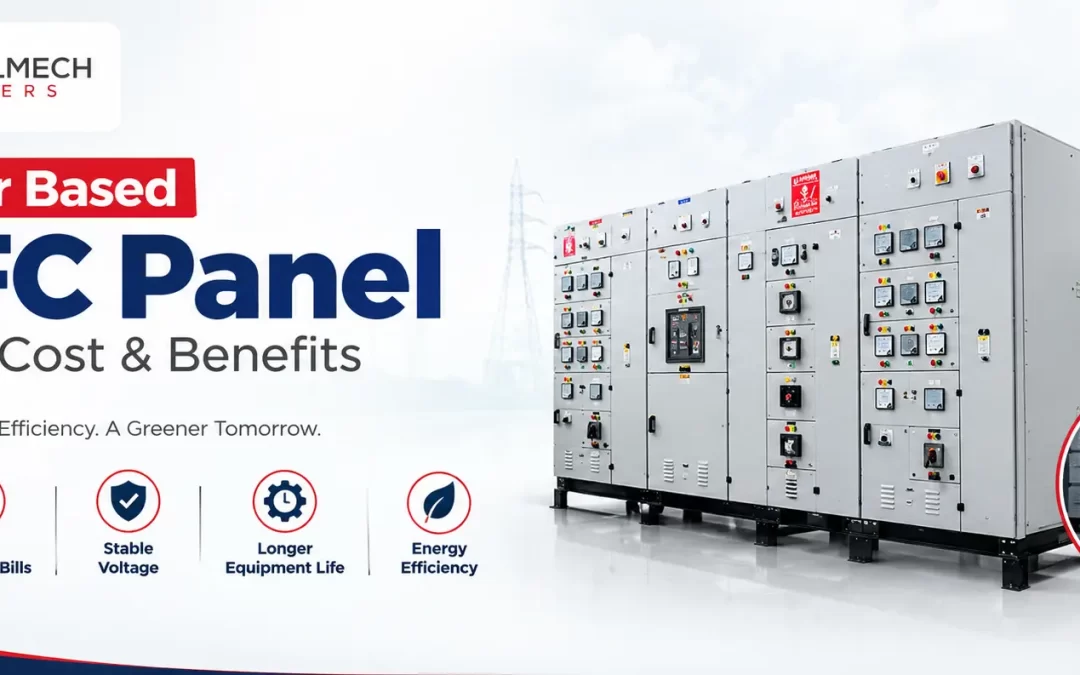
What Is a Thyristor Based APFC Panel? Working, Cost & Benefits
If your plant has welding machines, cranes, lifts, presses or any load that changes in a fraction of a second, a normal APFC panel may never keep up. By the time its contactors switch, the load has already changed, and your power factor (PF) swings between lagging and leading. The result is penalties, tripping and burnt contactors.
A thyristor based APFC panel (also called a thyristor switched capacitor or TSC panel) is built for exactly this problem. This guide explains what it is, how it works, what it costs and whether you really need one.
Table of Contents
- What Is a Thyristor Based APFC Panel?
- Why Conventional Contactor Panels Struggle
- How a Thyristor APFC Panel Works
- Main Components Inside the Panel
- Thyristor vs Contactor APFC Panel
- Key Benefits
- Where to Use It (Applications)
- Cost of a Thyristor APFC Panel
- How to Choose the Right Panel
- Common Mistakes to Avoid
- Maintenance Tips
- FAQs
- Conclusion
1. What Is a Thyristor Based APFC Panel?
1.1 Simple Definition
A thyristor based APFC panel is an automatic power factor correction panel that uses solid-state switches (thyristors/SCRs) instead of electromechanical contactors to connect and disconnect capacitor steps.
1.2 What Is a Thyristor?
A thyristor is a semiconductor switch with no moving parts. Two thyristors connected back-to-back can switch an AC circuit on at a precisely chosen moment in the voltage waveform. This precise timing is the key to its performance.
1.3 The Short Version
- Contactor APFC: slow, mechanical, suited to steady loads
- Thyristor APFC: fast, silent, suited to rapidly changing loads
2. Why Conventional Contactor Panels Struggle
2.1 Slow Response
A normal APFC controller waits several seconds (often 5 to 60) between switching steps. This delay is deliberate, since capacitors must discharge before being reconnected. For fast-changing loads, that is far too slow.
2.2 Inrush Current
When a contactor connects a discharged capacitor, a very large inrush current flows for a moment. It stresses the capacitor, contacts and supply, and it can cause voltage dips.
2.3 Contactor Wear
Contactors are rated for a limited number of operations. On a load that fluctuates constantly, they wear out or weld their contacts, and the panel quietly stops correcting.
2.4 Over- and Under-Correction
Because the panel lags behind the load, it often leaves the system under-corrected at peaks and over-corrected when the load drops suddenly.
3. How a Thyristor APFC Panel Works
3.1 Step-by-Step Working
- Measurement: A controller continuously reads voltage and current through a CT and calculates the reactive power needed.
- Decision: It decides how many capacitor steps are required and issues a firing command.
- Switching at the right instant: The thyristor module turns on at the moment when the supply voltage equals the voltage already on the capacitor (zero-crossing or zero-voltage-difference switching).
- No inrush: Because the voltages match at switch-on, the transient current is almost eliminated.
- Disconnection: The thyristors stop conducting at a natural current zero, so the capacitor is disconnected smoothly.
- Repeat: This can happen within a few cycles of the supply (milliseconds to about a hundred milliseconds depending on design), thousands of times a day.
3.2 Why Zero-Crossing Switching Matters
It removes the stress that normally destroys capacitors and contactors, which is why thyristor panels tolerate frequent switching so well.
3.3 Discharge Requirement
A capacitor that has been disconnected still holds charge. Good thyristor panels use fast-discharge arrangements or intelligent control so a step can be reconnected quickly without switching at the wrong moment.
4. Main Components Inside the Panel
4.1 Thyristor Switching Modules
Back-to-back SCRs, usually with heat sinks and sometimes a cooling fan. They are the heart of the panel.
4.2 Fast Controller
A dedicated thyristor-rated PF controller, much faster than a standard APFC relay.
4.3 Capacitors
Heavy-duty or APP (all polypropylene) capacitors rated for frequent switching.
4.4 Detuned Reactors
Used in most installations, commonly 7% or 14%, to protect capacitors from harmonics and avoid resonance.
4.5 Protection Devices
HRC fuses or MCCB, surge protection, temperature sensors and over-voltage protection.
4.6 Optional Bypass Contactors
Some designs add a bypass contactor across the thyristor once a step is on, which reduces heat losses.
5. Thyristor vs Contactor APFC Panel
|
Feature |
Contactor APFC |
Thyristor APFC |
|
Switching device |
Electromechanical contactor |
Solid-state SCR module |
|
Response time |
Seconds |
Milliseconds to a few cycles |
|
Inrush current |
High |
Very low |
|
Switching life |
Limited |
Practically unlimited |
|
Noise |
Audible clicks |
Silent |
|
Best for |
Steady or slow-changing loads |
Fast, fluctuating loads |
|
Heat generation |
Low |
Higher (needs ventilation) |
|
Initial cost |
Lower |
Higher |
6. Key Benefits
6.1 Near-Instant PF Correction
PF stays close to target even when the load jumps from zero to full in a moment.
6.2 Longer Capacitor and Component Life
No inrush and no mechanical wear mean fewer failures and lower replacement cost.
6.3 Avoids Penalties Fully
Where PF is averaged, slow panels can still leave penalties. Fast correction keeps PF steady.
6.4 Voltage Stability
Rapid reactive power support reduces voltage dips and flicker on weak supplies.
6.5 Fewer Breakdowns
Welding lines, lifts and presses run more reliably when voltage and PF stay stable.
6.6 Silent, Low-Maintenance Operation
No clicking contactors and nothing to replace on a regular schedule.
7. Where to Use It (Applications)
7.1 Strong Fit
- Spot and seam welding units
- Cranes, hoists and elevators
- Injection moulding and press machines
- CNC machines with rapid load cycles
- Rolling mills, crushers and sawmills
- Wind and solar sites with fast-changing reactive demand
- Hospitals and data centres with sensitive loads
7.2 Not Necessary
Plants with stable, slow-changing loads (pumps, fans, continuous process lines) are usually served well by a standard detuned APFC panel at lower cost.
8. Cost of a Thyristor APFC Panel
8.1 Why Prices Vary So Much
Cost depends on kVAR rating, number of steps, make of thyristor modules and capacitors, reactor percentage, enclosure and cooling.
8.2 Indicative Pricing
As a rough guide in the Indian market, a thyristor panel typically costs about 1.5 to 2.5 times a comparable contactor-based panel of the same kVAR. Treat any figure as a ballpark, since market prices change with brand and copper/semiconductor costs. Always compare at least two or three quotations on the same specification.
8.3 What to Include in a Fair Comparison
- Total kVAR and step size
- Detuning percentage
- Capacitor type (APP vs MPP)
- Make of thyristor module and controller
- Warranty and service support
8.4 Payback
For a plant with real penalties or frequent capacitor and contactor failures, payback often falls within one to two years. If your load is steady, the extra cost may not be justified.
9. How to Choose the Right Panel
9.1 Study Your Load Profile
Log PF and kW at short intervals (seconds, not just monthly). If PF swings widely within minutes or seconds, a thyristor panel is worth considering.
9.2 Measure Harmonics
Ask for a harmonic analysis. Choose the correct detuning reactor to avoid resonance.
9.3 Check the Switching Speed You Actually Need
Not every site needs millisecond response. Match the technology to the load.
9.4 Mixed Approach
A common cost-effective design combines a thyristor stage for the fluctuating portion with contactor stages for the steady base load.
9.5 Verify Ventilation and Space
Thyristors produce heat. The panel room needs adequate airflow or cooling.
10. Common Mistakes to Avoid
10.1 Buying Thyristor Where Contactor Is Enough
You pay extra without any gain on a stable load.
10.2 Skipping the Harmonic Study
Harmonics remain the top cause of early capacitor failure, even with thyristor switching.
10.3 Using Ordinary Capacitors
Use capacitors rated for frequent switching duty.
10.4 Poor Controller Setup
Wrong CT ratio, polarity or target PF will defeat even the best hardware.
10.5 Ignoring Heat
Blocked ventilation shortens the life of the thyristor modules.
11. Maintenance Tips
- Check capacitor current every month with a clamp meter
- Clean dust from heat sinks and fans every quarter
- Inspect for bulging capacitors and discoloured terminals
- Tighten power connections periodically
- Verify controller settings after any load change
- Review PF trends to catch a failing step early
12. Frequently Asked Questions
12.1 What is a thyristor based APFC panel?
It is an automatic power factor correction panel that switches capacitor steps using thyristors instead of contactors, giving very fast, inrush-free correction.
12.2 How is it different from a normal APFC panel?
A normal panel uses contactors and responds in seconds. A thyristor panel responds in milliseconds and handles frequent switching without wear.
12.3 Is a thyristor APFC panel worth the extra cost?
Yes, for fast-changing loads like welding, cranes and presses. For steady loads, a standard detuned APFC panel is usually enough.
12.4 Does it need detuned reactors?
In most plants, yes. Reactors protect capacitors from harmonics and prevent resonance.
12.5 How fast can it switch?
Typically within a few cycles of the supply frequency, which is milliseconds to roughly a hundred milliseconds depending on the design.
12.6 Can it be used with a generator?
Yes, but correction must be sized carefully so it does not cause leading PF or voltage rise at light generator load.
12.7 Does it produce more heat?
Yes. Thyristor modules dissipate some heat, so ventilation matters. Bypass-contactor designs reduce this.
13. Conclusion
A thyristor based APFC panel is the right tool when your load changes faster than a contactor can follow. It removes inrush current, protects capacitors, keeps PF steady and prevents penalties on welding, crane, press and other fluctuating loads. It costs more than a standard panel, so measure your load profile and harmonics first, and choose thyristor switching only where it truly adds value.