




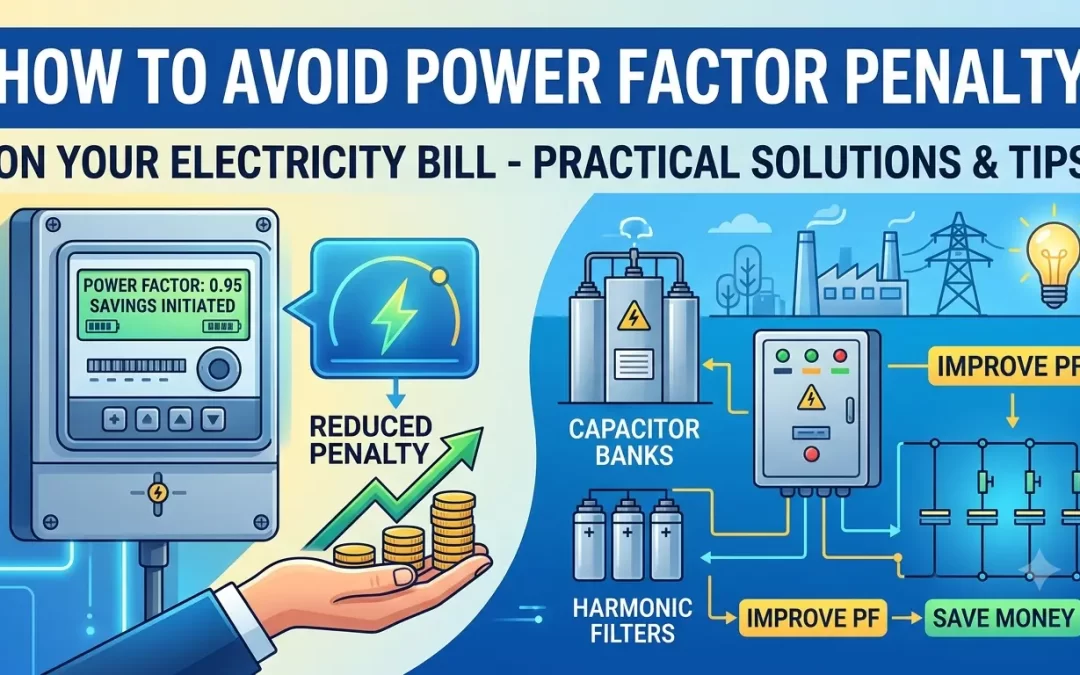
How to Avoid Power Factor Penalty on Your Electricity Bill (DHBVN, UPPCL, MSEDCL)
If your factory, workshop, hospital or commercial building gets a “low power factor surcharge” every month, you are paying extra for electricity you never actually used productively. The good news is that this is one of the easiest bill items to fix. In most cases the payback on correction equipment is under 12 months.
This guide explains what power factor is, how Haryana (DHBVN), Uttar Pradesh (UPPCL) and Maharashtra (MSEDCL) consumers get penalised, and exactly how to eliminate the penalty.
Table of Contents
- What Is Power Factor?
- Why Low Power Factor Costs You Money
- How DHBVN, UPPCL and MSEDCL Treat Power Factor
- Common Causes of Low Power Factor
- How to Calculate the Capacitor Size You Need
- 7 Proven Ways to Avoid Power Factor Penalty
- APFC Panel vs Fixed Capacitors
- Mistakes That Bring the Penalty Back
- Maintenance Checklist
- FAQs
- Conclusion
1. What Is Power Factor?
1.1 Simple Definition
Power factor (PF) is the ratio of useful power (kW) to total power drawn from the grid (kVA). It is a number between 0 and 1.
PF = kW ÷ kVA
A PF of 0.95 means 95% of the current you draw does real work. A PF of 0.70 means only 70% does, and the rest just circulates in your wiring.
1.2 The Three Types of Power
- Active power (kW): does the real work: turning motors, producing heat and light.
- Reactive power (kVAR): needed to create magnetic fields in motors and transformers. It does no work but must be supplied.
- Apparent power (kVA): the combination of both. This is what the utility’s wires and transformers must carry.
1.3 An Easy Analogy
Think of a glass of beer. The liquid is active power (what you want), the foam is reactive power (takes up space, gives nothing), and the full glass is apparent power. The more foam, the lower your power factor.
2. Why Low Power Factor Costs You Money
2.1 Higher Current, Higher Losses
For the same kW load, lower PF means higher current. Losses in cables and transformers rise with the square of current, so a PF drop from 0.95 to 0.75 raises current by about 27% and I²R losses by about 60%.
2.2 Higher Maximum Demand (kVA)
Many HT and large LT consumers pay demand charges on kVA, not kW. Low PF directly inflates kVA and your fixed charges.
2.3 kVAh Billing
Under kVAh billing, energy itself is billed on apparent energy. Every unit of reactive energy is then charged like real energy, and a penalty is effectively built in, whether or not a separate surcharge line appears.
2.4 Hidden Costs
Overloaded transformers, voltage drop, tripping breakers and reduced capacity for adding new machines all come from poor PF.
3. How DHBVN, UPPCL and MSEDCL Treat Power Factor
Each state regulator (HERC, UPERC, MERC) sets its own rules in the tariff order, and these are revised periodically. Here is the general picture.
3.1 DHBVN (Haryana)
Industrial and large commercial consumers are monitored on average monthly PF, with a surcharge when PF falls below the prescribed benchmark (commonly around 0.90). Many bulk-supply categories are on kVAh billing, so low PF raises the bill directly.
3.2 UPPCL (Uttar Pradesh)
Large and HT consumers face a low-PF surcharge, and some categories receive a rebate for maintaining high PF. UP has also moved a number of categories toward kVAh-based billing.
3.3 MSEDCL (Maharashtra)
MSEDCL is well known for its two-way system: an incentive for PF above roughly 0.95 and a penalty for PF below roughly 0.90, with the penalty slab increasing as PF drops further.
3.4 Important Note
Percentages and thresholds change with every tariff order. Check your latest bill’s PF line and the current order on the official site of your regulatory commission (HERC, UPERC, MERC) before sizing equipment. Your target should be 0.95 to 0.99, which keeps you safe under any of the three utilities and earns incentives where available.
4. Common Causes of Low Power Factor
4.1 Lightly Loaded Induction Motors
A motor running at 30–40% load can have a PF of just 0.4–0.6. Oversized motors are the number one culprit.
4.2 Transformers Running Under Load
Transformers draw magnetising current regardless of load, so lightly loaded ones drag PF down.
4.3 Other Common Sources
- Welding machines and arc furnaces
- Fluorescent lighting with old magnetic ballasts
- Air compressors and chillers cycling at low load
- Variable loads such as cranes and lifts
- Harmonic-rich loads (VFDs, UPS, LED drivers, rectifiers)
5. How to Calculate the Capacitor Size You Need
5.1 The Formula
Required kVAR = kW × (tan φ₁ − tan φ₂)
where φ₁ is the angle for existing PF and φ₂ is the angle for target PF.
5.2 Worked Example
A factory runs at 100 kW with an existing PF of 0.75. Target PF is 0.95.
- tan φ₁ (PF 0.75) = 0.882
- tan φ₂ (PF 0.95) = 0.329
- Required kVAR = 100 × (0.882 − 0.329) = about 55 kVAR
Result: apparent power falls from 133 kVA to about 105 kVA, which means about 21% lower current and a smaller demand charge.
5.3 Practical Sizing Tips
- Use your highest running load from past bills, not the connected load.
- Round up to the nearest standard APFC step configuration.
- Do not overcompensate, since leading PF can also be penalised and causes overvoltage.
6. 7 Proven Ways to Avoid Power Factor Penalty
6.1 Install an APFC Panel
An Automatic Power Factor Correction panel switches capacitor steps in and out based on real-time load. It is the best option for most industries.
6.2 Use Fixed Capacitors at Individual Motors
For large motors that run steadily, a capacitor directly across the motor terminals corrects PF at the source and reduces cable losses.
6.3 Right-Size Your Motors
Replace consistently under-loaded motors with correctly sized, high-efficiency (IE3/IE4) ones.
6.4 Use Detuned Reactors Where Harmonics Exist
If you run VFDs or UPS systems, plain capacitors can resonate with harmonics and fail. Use detuned (reactor-protected) capacitor banks, commonly 7% or 14%.
6.5 Switch Off Idle Equipment
Idling motors and transformers waste kVAR. A simple shutdown routine helps.
6.6 Consider Synchronous Condensers or Active Filters
For very large or fast-changing loads, an active harmonic filter or SVG gives dynamic correction.
6.7 Monitor PF Continuously
Install a multifunction meter or energy analyser and review PF weekly. You catch capacitor failure early and avoid a surprise penalty on the next bill.
7. APFC Panel vs Fixed Capacitors
7.1 When Fixed Capacitors Make Sense
Constant loads, single large motors and small installations on a tight budget.
7.2 When APFC Is the Better Choice
Variable loads, multi-machine plants, and any site with a changing shift pattern.
7.3 Quick Comparison
|
Feature |
Fixed Capacitor |
APFC Panel |
|
Response to load change |
None |
Automatic |
|
Risk of over-correction |
High |
Low |
|
Initial cost |
Lower |
Higher |
|
Best for |
Constant load |
Variable load |
|
Maintenance |
Minimal |
Periodic checks |
8. Mistakes That Bring the Penalty Back
8.1 Ignoring Capacitor Ageing
Capacitors lose capacity over time, often 2–3% per year. A bank that corrected PF three years ago may now fall short.
8.2 Skipping Harmonic Study
Harmonics are the leading reason capacitors fail early.
8.3 Poor Controller Settings
A wrongly set target PF or CT ratio can leave the panel doing nothing.
8.4 Loose Connections and Blown Fuses
One failed step quietly reduces your correction until the next bill arrives.
9. Maintenance Checklist
- Check capacitor current monthly with a clamp meter
- Inspect for bulging, leakage or overheating
- Tighten power terminals every quarter
- Verify controller settings and CT polarity
- Replace failed contactors and fuses promptly
- Re-measure PF after any major load change
10. Frequently Asked Questions
10.1 What is the ideal power factor to avoid penalty?
Aim for 0.95 to 0.99. This stays above the usual penalty thresholds and, in Maharashtra, can earn an incentive.
10.2 Does the power factor penalty apply to residential consumers?
Generally no. It applies mainly to industrial, commercial and HT consumers with measured kVA or kVAh billing.
10.3 How fast can I recover the cost of an APFC panel?
Most industries see payback within 6 to 18 months, depending on how large the penalty was.
10.4 Can too many capacitors cause problems?
Yes. Over-compensation creates leading PF, voltage rise and possible penalties. This is why automatic correction is preferred.
10.5 Is kVAh billing the same as a PF penalty?
Not exactly, but it works similarly. With kVAh billing, a poor PF increases billed units directly.
10.6 How do I find my current power factor?
It is printed on your monthly bill, or you can measure it with a power analyser.
10.7 Do LED lights improve power factor?
Good-quality LED drivers have high PF, but cheap ones can have PF below 0.5 and add harmonics.
11. Conclusion
A power factor penalty is not a fixed cost of doing business. It is a technical problem with a clear solution. Measure your PF, calculate the kVAR you need, install a properly sized APFC panel (with detuned reactors if you have harmonics), and monitor it regularly. Whether you are billed by DHBVN, UPPCL or MSEDCL, keeping PF at 0.95 or above lowers your bill, frees up transformer capacity and protects your equipment.
Need help sizing a capacitor bank or APFC panel for your plant? Contact the SuperElmech team for a free load assessment and quotation today.